
28.05.2026
Analytical Report for the Period: November 2025 – April 2026
The KIDS OF UKRAINE SviTY Program is a comprehensive initiative aimed at providing holistic support and psychological recovery for adolescents affected by the war. The program operates in four centers: Lviv, Khmelnytskyi, Cherkasy, and Zhytomyr, and reaches 250–300 adolescents in each center annually. Against the backdrop of the war in Ukraine, which has placed approximately 7.5 million children at extreme risk to their mental and physical health, this program is of particular importance. This study compares indicators of emotional well-being and social adaptation among adolescent participants of the SviTY Program before they began attending the program and after six or more months of participation.
2. Research Methodology
- Data sources: an entry questionnaire completed at the start of the program by 158 respondents, and an exit questionnaire completed after six or more months of participation by 138 respondents.
- Paired analysis: 91 children with both entry and exit questionnaires available were analyzed, representing 58.9% of the sample. Format of adolescents’ participation: offline – 74.2%; online – 25.8%.
- Indicators assessed: overall emotional state on a scale of 1 to 5; frequency of negative emotions, including fear, anxiety, sadness, and anger, measured in days per month; frequency of the positive emotion of joy; self-confidence on a scale of 1 to 5; sense of being needed and supported by others on a scale of 1 to 5; and quality of communication with peers and adults on a scale of 1 to 5.
- Frequency conversion: text-based responses were converted into days per month: «once a day» = 30, «once a week» = 4, «once a month» = 1, and «I do not feel this at all» = 0.
3. Research Results
3.1. Overall Emotional State
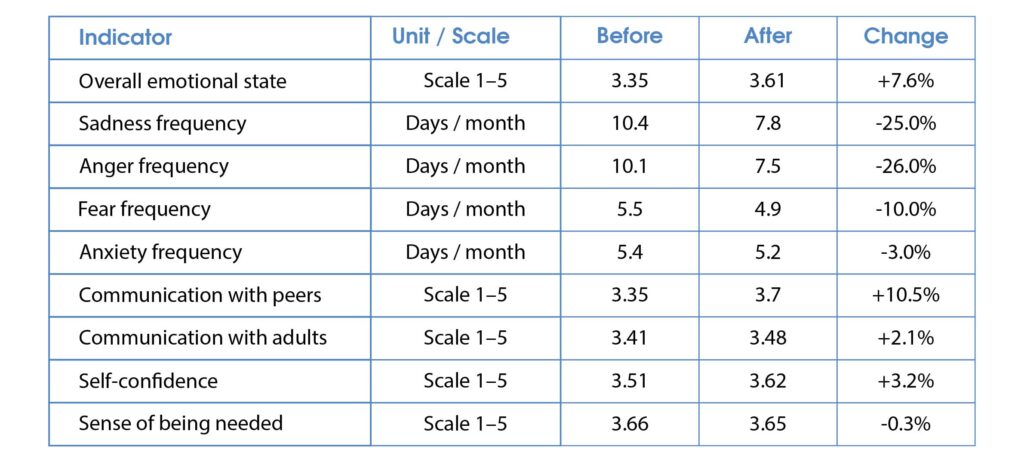
After participation in the program, the average emotional state score increased from 3.35 to 3.61, representing an improvement of 7.6%. This moderate but statistically significant increase indicates the positive impact of SviTY Program on children’s mood and energy levels. Participants reported a significant improvement in mood and a reduction in fears after attending activities at the centers. This is consistent with international observations: conflict-related circumstances generate high levels of fear and anxiety among children, but with appropriate support, most children can successfully cope with them.
3.2. Dynamics of Negative Emotions
A decrease was observed across all analyzed negative emotions. More specifically:
- Sadness: the frequency of feeling sad decreased by 25% (from 10.4 to 7.8 days per month). This is the most significant improvement among all negative emotions, indicating that children began to feel depressed less often.
- Anger: a decrease of 26% (from 10.1 to 7.5 days per month). This dynamic suggests that participants learned to regulate their emotions better and respond to stressful situations more constructively.
- Fear: a decrease of 10% (from 5.5 to 4.9 days per month). This noticeable reduction is an indicator of a growing sense of safety, supported by the work of psychologists.
- Anxiety: only a 3% decrease (from 5.4 to 5.2 days per month). This indicates that anxiety among children remains a problematic area and requires increased attention. Overall, the decrease in the frequency of fear and anxiety is consistent with research findings: interventions with children affected by war demonstrate a significant reduction in these emotional symptoms, although a certain level of anxiety may persist even with support.
3.3. Social Adaptation and Communication
Communication with peers: the most noticeable improvement was recorded in this area – +10.5%, with the average score increasing from 3.35 to 3.70. This shows that the program effectively promotes socialization: participants find it significantly easier to establish friendships, adapt to a new group, and feel part of a community.
Communication with adults: a moderate improvement of +2.1% (from 3.41 to 3.48). This suggests that after the program, children became somewhat more open to contact with adults, although progress in this area is more gradual.
3.4. Self-Confidence and Sense of Being Needed
Self-confidence: increased by 3.2% (from 3.51 to 3.62). Participants reported becoming more confident in their own abilities and more open. The SviTY Program provides unconditional acceptance and support, which significantly improves children’s self-esteem and belief in themselves. Interventions focused on developing emotional skills demonstrate an increase in adolescents’ self-confidence, and our results confirm this.
Sense of being needed: remained almost unchanged (from 3.66 to 3.65). According to survey data, about half of parents believe that their children have a sufficient level of support from family and close ones. The stability of this indicator suggests that children received sufficient emotional support from their environment both before and after the program.
4. Conclusions
The analysis of 91 paired questionnaires confirms that the SviTY Program has a positive impact on the psycho-emotional state of children affected by the war. In particular:
- Improvement in overall emotional state: participation in the program contributed to the recovery of children’s mood (with a 7.6% increase). This corresponds to feedback from participants about a «significant improvement in mood» and the «disappearance of anxious thoughts».
- the most substantial effect was observed in adolescents’ communication with peers, which improved by 10.5%. The program helps them establish friendships and build a network of mutual support.
- Reduction in negative emotions: sadness and anger decreased most significantly, by 25% and 26% respectively. This demonstrates the effectiveness of emotional regulation training: adolescents began to experience less depression and aggression.
- Fear and anxiety: the average decrease in fear (by 10%) combined with a slight decrease in anxiety (by 3%) shows progress in children’s sense of safety, while also indicating that anxiety remains the most persistent challenge. This is consistent with the findings of other studies: interventions can reduce fear and anxious thoughts, but fully overcoming anxiety often requires additional efforts.
- Self-confidence: increased by 3.2%. The program creates an atmosphere of acceptance, which contributes to the growth of children’s self-confidence.
- Sense of being needed: remained at a stable and relatively high level, confirming that close ones and parents provide the necessary support in everyday life.
5. Recommendations
Based on the results, the following recommendations are proposed:
- 5.1. Strengthen work with anxiety: since anxiety proved to be the least responsive to current interventions, it would be advisable to add specialized relaxation and grounding techniques, including breathing exercises, meditative exercises, and creative methods for relieving tension. It would also be appropriate to conduct group mindfulness sessions and organize individual consultations for children with the highest levels of anxiety.
- 5.2. Expand socialization programs: given the strongest improvement in communication with peers, the number of group activities and team projects should be increased, including team-building activities, role-playing games, and interest-based meetings. More informal events and gatherings should be organized to help participants get to know one another. Creating a mentorship system between older and younger adolescents would contribute to group cohesion (SviTY PRO). Regular excursions and trips, including camps and outings, would also strengthen the sense of unity.
- 5.3. Continue emotional regulation training: given the reduction in anger and sadness, existing practices such as group trainings and self-awareness techniques have proven effective. They should be maintained and expanded by increasing session time and adding exercises focused on emotional awareness.
- 5.4. Individual approach: identify children with consistently low indicators of adaptation and emotional well-being. Such adolescents should be provided with individual psychological consultations, with parents involved in the process where appropriate.
- 5.5. Monitoring and evaluation: continue regular participant surveys, monthly or every three to six months, to monitor results in a timely manner. Qualitative methods, including focus groups and interviews, should be added to the study to gain a deeper understanding of changes in children.
QUALITATIVE ANALYSIS
1. What Participants Like Most About the Program
According to the content analysis of open-ended responses, participants most often mention the friendly atmosphere, opportunities for communication, and creative activities. Four main categories were identified:
- Communication and friendship (mentioned most frequently). Adolescents value the opportunity to find new friends and like-minded peers: «Communication with peers, the opportunity to find common interests», «Many interesting people who are pleasant to talk to». These findings are consistent with studies showing a significant positive relationship between peer support and successful social adaptation among internally displaced adolescents. In other words, friendly relationships within the SviTY centers contribute to improved psychological well-being and create a sense of support.
- Trainings and workshops. Participants mention a variety of practical and creative activities, including «Psychological Trainings», «Creative Workshops», and «Acting Classes». Involving children in creativity and acting allows them to express emotions and distract themselves from stress. Group trainings also develop new communication skills, and the value of such activities is emphasized by the participants themselves («Interesting sessions… where you can learn many new things»). The trainings and workshops of the SviTY Program, including acting and creative activities, help adolescents feel safe and reduce their level of anxiety.
- Excursions and trips. Participants speak positively about off-site activities: «Excursions, trainings, and cinema», «Trips somewhere», and «Events when we go to new places». A change of environment and shared trips contribute to group cohesion and provide new experiences. Participants note that joint trips strengthen interpersonal connections.
- Atmosphere and community. Children emphasize the friendly and supportive atmosphere: «A friendly group», «A pleasant atmosphere», «The people who work with us and the people who also attend SviTY». This corresponds to the social support model: a sense of belonging to a group and the understanding that «I am not alone» provide psychological support. Therefore, the main value of the program lies in creating a safe environment for communication, which is confirmed both by the participants themselves and by research literature.
2. Participants’ Recommendations for Changes
Most participants are satisfied with the program and do not express any serious concerns. Typical responses include: «Nothing, I like everything», «Everything is great», and «I am satisfied with everything». Among specific suggestions, the following are mentioned most often:
- More travel and outings. «More trips and activities», «Add more trips – they help us become friends». Given the high level of satisfaction with socialization, participants would like to have even more group outings. Additional excursions could strengthen the effect of social adaptation.
- Psychological sessions. «I would like there to be more psychology and psychological sessions». Several respondents suggested increasing the number of emotional regulation trainings, which is consistent with the identified issue of anxiety.
- Educational component. «Add more foreign languages», «Add sports activities». The desire to expand educational and active programs, including language courses and sports, indicates participants’ interest in gaining new knowledge and developing in different areas.
- Organizational suggestions. Some participants drew attention to age or group size, for example: «Set age limits», «There are too many children», as well as to the schedule, suggesting that «The time of sessions should be moved later».
3. Impact of the Program on Participants’ Lives
Participants’ feedback indicates real positive changes in their lives:
- New friends and acquaintances (mentioned most frequently). «I found many new friends here», «I have more friends now», «I now have people who will help me at any time». Interpersonal connections are a key result. This is consistent with scientific evidence showing that peer support significantly improves adaptation.
- Self-confidence. «I became much more confident in myself, started respecting my own opinion and loving myself», «Self-confidence and more friends». Participants report increased self-esteem and inner resilience. Similar programs are indeed associated with an increased sense of personal competence and reduced depressive symptoms.
- Socialization and communication. «I became more social», «It became easier to communicate with peers». Improved communication skills are one of the program’s strongest effects. This corresponds to the quantitative results, showing a 10.5% improvement in communication with peers, and to general trends in MHPSS programs, which typically help reduce isolation.
- Psychological support and emotional relief. «Psychological support and support at the right time», «The program showed me that I am not the only one like this». Creative group activities, including art therapy and relaxation exercises, create a constructive mechanism for adolescents to work with emotions. For example, creativity and acting help them shift attention away from negative experiences.
- New knowledge and worldview. «New acquaintances and a broader worldview», «I deepened my knowledge of interesting topics», «I learned many new things». The additional knowledge and experience gained through sessions and trips broaden participants’ horizons. This is also part of the program’s positive effect: participants gain knowledge that increases their overall engagement and motivation.
4. Key Quotes from Participants
Below are some of the most vivid participant responses, translated as closely as possible:
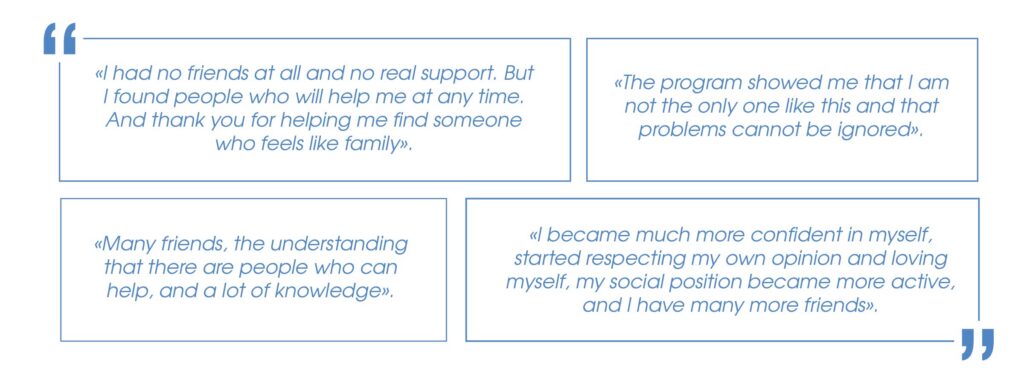
These quotes illustrate typical results: friendly support, confidence, and new knowledge.
5. Conclusions
Based on the data analysis, the following conclusions can be drawn:
- Positive impact on emotional well-being. Participants reported a noticeable reduction in negative emotions, especially sadness and anger, and an improvement in overall well-being.
- Socialization as an important outcome. The most pronounced change was observed in the area of communication: adolescents actively find friends and feel social support. This is consistent with the hypothesis that communication and group support are key factors in the recovery of traumatized children.
- Support for self-esteem. Participants’ sense of self-worth and confidence in their abilities increased. This is important for adolescents’ resilience in times of crisis. At the same time, it should be taken into account that certain issues, such as anxiety, remain relevant.
- High level of satisfaction. Most participants do not feel the need for major changes. Responses such as «Do not change anything» are the most common. This indicates the overall effectiveness and attractiveness of the program.
6. Summary
The SviTY Program demonstrates significant positive results: children’s emotional well-being improves, their socialization and self-confidence increase, and the number of negative emotional experiences decreases. The greatest value of the program lies in creating a safe and friendly community where children find support and friends. The quantitative and qualitative results confirm the relevance of continuing and scaling the program, taking into account the recommendations to strengthen the psychological component and expand the organization of activities.
Overall conclusion: The SviTY Program is an effective tool for the psychosocial support of children who have experienced war. The positive results, including improved emotional well-being, better communication, and reduced negative emotions, confirm its value.
