
30.11.2025
Topic: Psychological state and its changes among visitors of the SviTY Center.
Objective: To assess the emotional state of teenagers who have attended the Center for over six months and to analyze the program’s positive impact on their resilience and socialization.
General Information
The study involved 70 teenagers who participated in the SviTY program in different formats:
- offine 50 participants;
- online 15 participants;
- mixed 5 participants.
Among respondents, girls constituted the majority (48), boys – 20, and 2 participants did not specify their gender. The survey was conducted at the beginning of the program and repeated six months later to evaluate changes in psychological state, self-esteem, social skills, and overall sense of well-being.

1. Emotional State
After six months of participation, a noticeable improvement in emotional well-being was observed:
- The share of those who feel good or very good increased from 59% to 71% (+12 percentage points).
- The number of participants who rated their condition as poor or very poor decreased threefold – from 13% to 4%. — з 13% до 4%.
These results indicate a reduction in emotional exhaustion and anxiety, alongside greater internal stability. The program provided a safe and supportive environment where participants could recover from stress caused by war and displacement.
2. Frequency of Negative Emotions (fear, anxiety, sadness, anger)
Negative emotions decreased across all indicators:
- Fear is felt less often: the share of those who do not feel fear at all increased from 15% to 26%, while those who feel it daily fell threefold (from 24% to 8%).
- Feelings of anxiety and sadness showed similar dynamics – over half of respondents reported a noticeable decrease in their intensity.
- The number of participants who feel anger daily halved, while those who almost never feel it increased from 12% to 17%.
Psycho-educational sessions, emotional intelligence workshops, and group support contributed significantly to reducing anxiety and emotional tension. This is an important indicator of the program’s effectiveness as a psychosocial stabilization tool for teenagers.
3. Self-Confidence
Teenagers’ self-confidence more than doubled:
- Before joining the program, only 37% of respondents described themselves as confident or very confident.
- After six months, that share rose to 74% (+37 percentage points).
- The number of those lacking confidence fell from 64% to 28%.
This is one of the most remarkable results. Many participants previously struggled with low self-esteem and uncertainty caused by social isolation or trauma. Through SviTY program, they were able to express themselves, explore new roles, and recognize their strengths. Growing confidence directly correlates with the development of resilience and active civic engagement.
4. Communication Skills
Communication skills improved significantly in interactions with both peers and adults:
- easiness of communication with peers grew from 45% to 84% (+39 percentage points);
- with adults – from 38% to 70% (+32 percentage points).
This demonstrates greater social confidence and readiness for interaction. For displaced teenagers who often experience social withdrawal, this indicates successful integration into a new environment. SviTY program fostered a friendly, inclusive atmosphere where participants learned to communicate openly and without fear of judgment.
5. Sense of Belonging and Support
A strong increase in the sense of personal value within the community was recorded:
- the share of those who feel needed or highly valued grew from 58% to 78% (+20 percentage points);
- those who felt unnecessary decreased from 30% to 16%.
This is a key indicator of the program’s social impact. Teenagers who previously felt lonely or alienated began to perceive themselves as important part of a community. This reflects the restoration of a basic sense of safety and social belonging – a crucial factor for emotional well-being.
6. Overall Psycho-Emotional State
- 97% of participants now report feeling cheerful and in a good mood (compared to 67% before).
- The share of those who feel calm and relaxed increased from 61% to 97%.
The program has established a stable environment that promotes emotional recovery, relaxation, and a reduction in chronic stress symptoms. This highlights the effectiveness of group and creative formats in supporting adolescents who have gone through crisis situations.
7. Qualitative Findings and Participants’ Reflections
An analysis of open-ended survey responses confirms the SviTY program’s strong emotional and social impact. The most common themes mentioned by participants were: forming new friendships, gaining self-confidence, and feeling supported psychologically.
Social Integration and Friendships
Over 80% of responses mentioned new friends, warm atmospheres, and acceptance. For many teens SviTY became the first safe space where they felt a sense of belonging:
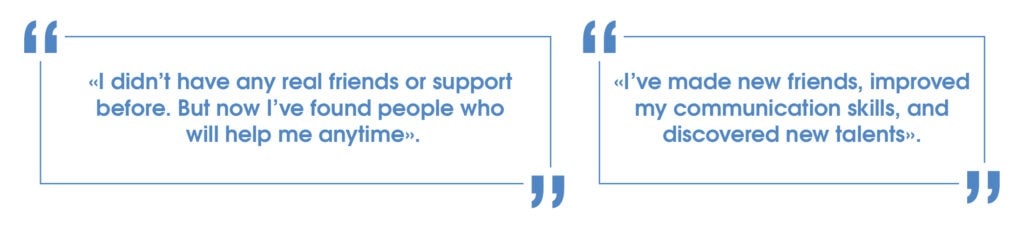
These statements show that SviTY effectively supports socialization and helps teenagers, including displaced ones, adapt to new communities.
Emotional Recovery and Self-Confidence
Many respondents shared that through the program they became more confident, calm, and open to communication:
- «I’ve become more social».
- «I’m more confident now and communicate more with my peers».
- «SviTY gave me a push toward self-development… I’ve become more open with people».
This proves the program’s therapeutic value – its activities (trainings, creative sessions, psychological meetings) foster emotional resilience and self-awareness.
Psychological Support and Self-Discovery
Several participants noted that they received crucial psychological support and better understood themselves and their needs:
- «It helped me understand myself and my needs».
- «I’ve become calmer and learned to accept my emotions».
- «SviTY helped me find my path in life».
These insights demonstrate that the program is more than just leisure – it serves as a psychosocial intervention that positively influences adolescents’ mental health.
Development of Interests and New Skills
Many participants noted that thanks to SviTY they discovered new areas of creativity, broadened their horizons and received inspiration for self-development:
- «I learned new drawing and crafting techniques».
- «I found out more about our country’s creative traditions».
- «New skills, new worldview, inspiration».
This emphasizes the program’s educational value and its role in fostering an active, curious youth community.
Summary
Participants showed consistent improvement across all key dimensions:
- anxiety and stress levels decreased by 30–50%;
- self-confidence nearly doubled;
- social engagement and sense of belonging increased by 20–30 percentage points.
A comparative analysis of the initial and final survey results demonstrates a clear improvement in emotional well-being, social confidence, and sense of support among teenagers participating in SviTY program.
Emotional state
After six months, 71% rated their emotional state as good or very good – 12% higher than at the start. Meanwhile, the number regularly experiencing fear, anxiety or sadness has more than halved. This confirms SviTY’s effectiveness in reducing distress and helping participants cope with emotional challenges caused by war.

Self-confidence
One of the most notable outcomes is the growth in self-confidence – from 37% to 74%. The program offers a safe space where teenagers can explore, experiment, and receive peer and mentor support, fostering self-esteem and active engagement.

Improvement in social skills
Significant improvement in social skills was also observed: if at the beginning of participation only 45% easily found a common language with their peers, then after – already 84%, a similar trend is observed in interactions with adults (+39 percentage points). This shows that SviTY successfully develops communication, trust, and social integration.

A sense of being needed
Importantly, 78% of participants now feel needed in their communities – 20% more than before. This indicates that SviTY not only develops skills but also helps young people feel valued, connected, and accepted.

Overall, the SviTY program demonstrates high effectiveness as a psychosocial support tool for teenagers, particularly among those displaced by war. It creates an environment of stability, growth, and mutual support – empowering resilient, confident, and socially active young people who can envision a future even amid challenging circumstances.
